


Concrete Block Mould
Material: For industrial applications, high-strength alloy steel is commonly used due to its strong resistance to deformation. Cast iron molds are less expensive but prone to cracking and deformation.
Dimensions: Common thicknesses are 4 inches, 6 inches, and 8 inches. The precision of the inner cavity directly affects the integrity of the block structure.
Wall Thickness Design: The mold walls must be sufficiently thick to withstand high-pressure vibrations while avoiding excessive weight increases that would increase costs.
Surface treatment: The inner walls must be smooth to reduce the adhesion of concrete and ensure easy removal from the mold.
Concrete block molds are a crucial tool in construction and masonry work for shaping wet concrete into standardized or specialized shapes of blocks.
Their design significantly impacts production efficiency, structural performance, and the final product’s appearance quality.
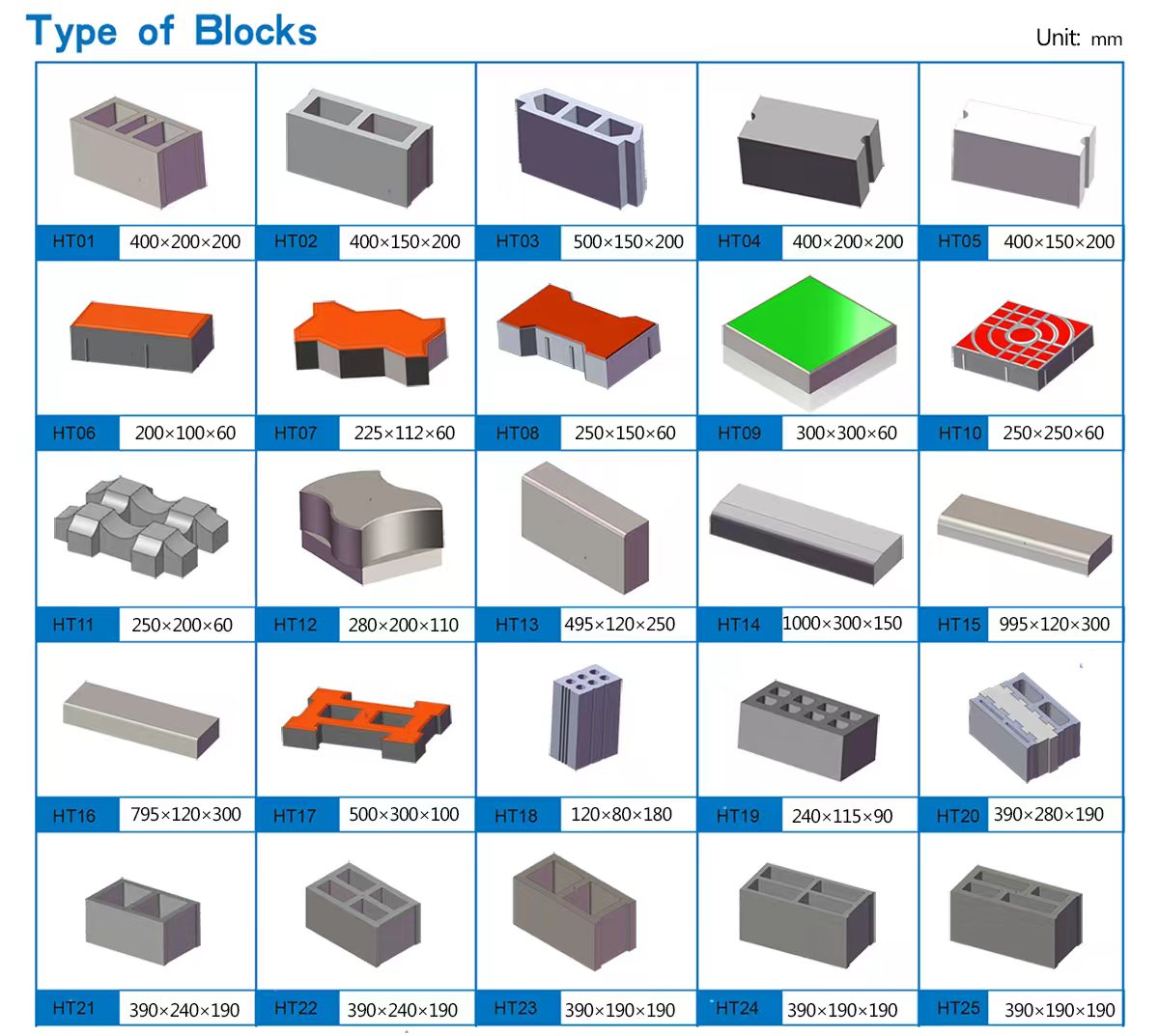
Main types.
Based on production requirements and final use, concrete block molds are primarily categorized into the following groups:
Single-block mold: Produces only one block at a time, suitable for small-scale, customized production, or repair projects. The advantages include flexible design, low initial investment, but lower production efficiency.
Multiple molds: These can be used to pour multiple blocks simultaneously, designed specifically for high-production environments. They significantly reduce unit labor costs and improve consistency, but they come with higher equipment costs and require more space.
Cellular block molds: Used for manufacturing lightweight blocks with cavities inside. These blocks can effectively reduce weight, improve thermal insulation and soundproofing properties, and decrease material usage. They are commonly used for non-load-bearing partition walls.
Solid block molds: Used to produce blocks with high density and strength, suitable for applications such as foundations, load-bearing walls, and retaining walls where high structural strength is required. However, they have a higher weight and poorer thermal insulation properties.
Interlocking block molds: These are used to produce blocks with mortise and tenon or pin-and-socket structures, which can be assembled without mortar. They are fast to install and are widely used in landscaping projects such as sidewalks, courtyards, and retaining walls..
 Material selection:
Steel molds: The most commonly used type. They offer high strength, wear resistance, and a long lifespan. They are often coated with Teflon or epoxy resin to facilitate demolding.
Steel-wood hybrid molds: These feature a steel framework combined with wooden interior linings. They are cost-effective and suitable for small to medium-sized or temporary projects.
Plastic molds: Lightweight, capable of producing complex textures (such as imitations of stone and wood), but relatively less durable. Commonly used for decorative paving bricks.

Frequently Asked Questions:
1,Are you a famous brand in block making machine mould industry?
Yes,we are top 5 supplier in China .
2,What can you do if I do not familiar with the block mould?
We have block sample for you to choose from,or you can share with us block picture,then we follow your picture to design moulds.
3,Why your price is not cheap than others?
Because our mould adopts a variety of heat treatment processes such as quenching, tempering, carburizing, and nitriding, which greatly enhances the wear resistance of the mold, thereby increasing the life of the mold.
4,How can I know I choose your mould is right?
We,Shandong Gaotang Huatong Hydraulic Pressure Machinery Co.,Ltd. Is a famous block making machine manufacture since 2004,our machine and mould had exported to over 30 countries in the world.Choose us,you can get the best quality mould you want,and it will make your business more better.


